

Author: JD

Netflix Brings Chris Tucker Out of Hiding for His First Ever Stand-Up Special
Netflix really doesn’t want you to leave your screens. The video streaming service even went to the ends of the earth to find comedian Chris Tucker and bring him out of hiding for his first full-length stand-up comedy special. Chris Tucker Live will air on the site July 10, The Hollywood Reporter announced today, and will dabble in everything from his experiences during childhood to his success in Hollywood. “Chris Tucker is a true global movie star and a one-of-a-kind talent whose remarkable energy, delivery and original style make him one of the funniest comedians of our time,” said Ted Sarandos, Netflix chief content officer. “We cannot wait to share his distinct and hilarious voice with our members across the globe.” Chris Tucker joins a list of comedians who have specials on Netflix including Aziz Ansari, Kevin Hart, Katt Williams and Chelsea Handler,

Are You Gonna Try Tidal ?
OUR VERDICT Tidal is a superb music streaming service, ideal for anyone with a penchant for hi-fidelity audio. For everyone else, it’s worth taking up the one week trial to see if the added quality is worth the extra cash. FOR Fantastic sound quality Excellent apps Lots of music videos Easy music discovery Lots of early features AGAINST Costs more than its rivals Library has holes in it Search needs optimising Some iOS niggles Tidal is a brand new music streaming service and it’s got a secret weapon – a USP that makes it stand out from the crowd. On the surface it looks just like Spotify. It’s got an excellent Chrome-based web player as well as decent iOS and Android apps. It offers comprehensive playlist functionality, sharing of music as well as offline listening. And the library is off to a good start with 25 million tracks. But instead of only serving up compressed music formats like MP3 and OGG – as do Spotify, Google Play Music and most of the others – Tidal offers music at CD quality. Yes, there’s finally a fully-fledged music service that streams FLAC at 1411kbps. And I can tell you now, it’s brilliant. Get your free one-week Tidal trial Tidal is more than just a FLAC streaming service though. It’s been designed from the ground up to be the ultimate music resource for fans of hi-fidelity music, offering playlists and recommendations curated by experienced music journalists, not to mention 75,000 music videos. If you’re struggling for space or using sub-hi-fi devices, you can also stream or download compressed formats. For the privilege of all this, Tidal Music will set you back double the outlay of a typical music streaming subscription – £20 a month instead of £10. Digsby IM, Email, and Social Networks in one easy to use application! http://kvors.com/click/?s=88377&c=89569&subid=21226 Why FLAC? For the uninitiated, FLAC is the format of choice for many people who want to listen to music files without having to put up with lossy formats like MP3. When you compress a music track into an MP3, you have to shave off a lot of detail in order to achieve that miniature file size. Other formats like OGG (as used by Spotify) do a highly commendable job of limiting that shaving mostly to parts of the audio that might be considered ‘inaudible’. But the truth is that all compression formats are a compromise, a victory for convenience over sound quality. FLAC tracks are also compressed but in a totally different way. They’re a lot more like a zipped file, so when they’re played back, they can be decompressed to their original glory without any loss of fidelity. Thus, while a CD track might take up anywhere between 60 and 100MB, a FLAC file will be more like 30 to 50MB. MP3s encoded at the maximum bitrate of 320kbps are typically only about 5-10MB in size, and there’s no way to get back the information you threw away during compression. That’s why MP3 is described as a lossy format while FLAC is not. The upshot of this is that FLAC is the perfect format for delivering CD-quality music down an internet pipe. And it’s about time it turned up in a truly decent streaming service. There are several other music services that offer FLAC, most notably the French service Qobuz which also offers buy-to-keep options. But arguably none that truly match Spotify for functionality and features. Read: the 5 best high-quality music streaming services The library is big, but not yet comprehensive Tidal Music Library Tidal launches to the public today with 25 million FLAC tracks in its library and that’s a good start. I used my CD collection and Spotify account to guide my search for all the music I would consider ‘mine’ and most of what I searched for was available. But also it wasn’t hard to find some omissions. One of my favourite bands, Wolf Parade, is completely absent. And there are plenty of bands for which you’ll only find one or two albums instead of the full roster. There were only two Bright Eyes albums available, The Strokes are completely absent, The Smiths’s catalogue is lacking some big’uns. This is disappointing, but it’s just how these services work in the early days. It takes time to get the tracks up and available, but new music is being added constantly so I would expect the omissions to be fixed sooner rather than later. The good news is that the ‘Your Music’ feature that Spotify added earlier this year is part of the Tidal service from day one. Big relief. It works in exactly the same way, allowing you to go through all your favourite bands and ‘star’ any album you’d like to add to your own personal music library. Once you’ve done this, they’re all waiting for you in your ‘My Music’ area. Remember to star the bands themselves at the same time, though, because unlike Spotify, Tidal won’t automatically add the tracks from those albums to ‘My Tracks’ and the artist isn’t auto added to ‘My Artists’ either. Sound quality is truly excellent, particularly using hi-fi grade equipment I also had issues with some music being mislabelled, a problem Spotify also suffered from in its early days. For instance, a search for ‘ELO’ yields just one album – Time. Search for Electric Light Orchestra, though, and you get the rest of the catalogue. This problem will sort itself out and really it’s not a big deal. The headlines are that most music I searched for – even obscure stuff – was ready and waiting for me. Using Tidal Music The fear with a brand new music service like this is that it starts off looking quite basic and feature-light. However, Tidal impresses from the first second you fire it up. The Chrome-based web player is visually very similar to Spotify, with a homescreen that offers links to curated playlists and recommended hi-fi albums as well as top 20 charts. It looks great and there’s no learning curve – it works exactly how you’d expect it to. A simple click on the sidebar will take you to your ‘My Music’ area where you’ll find all your stuff. And browsing music is very easy. You can’t search by genre, which might have been a great way to win over some Spotify subscribers, but there is a ‘Genres’ button you can click on in the sidebar which will take you to curated areas with playlists and recommended albums. A decent compromise. Select any genre to find tailored playlists and recommended albums Search generally isn’t terribly smart – misspell an album or artist name even by one character or one piece of punctuation, and you’ll be left with zero results. A bit of optimisation here wouldn’t hurt, but as long as you’re careful you won’t have any problems with it. And if you’re a fan of the ‘radio’ function on Google Play Music or Spotify, you’ll find an identical service ready and waiting in Tidal. You can select Artist radio or individual track radio, and it’s a great way to discover new music. From your user page you can access all the artists, playlists and albums you’ve favourited Social features In the settings, you can connect Tidal to Facebook which will allow you to share music with your friends. You can also extract a URL if you want to link someone to any album, playlist or track. But the social features are nowhere near as mature as the ones in Spotify – it’ll take a lot of work to catch up in that regard. But judging by the amount of care and attention that’s gone into Tidal pre-launch, I would expect that side of things to be developed quite quickly. Other formats In settings you can also change your streaming settings, so if you want to save bandwidth you can drop down a notch to 320kbps AAC or, if you’ve gone insane, all the way down to 96kbps AAC+. It’s important to have these settings, as I anticipate plenty of people using the FLAC service at home while opting for 320 AAC when they’re out and about. Those files are big, after all… Performance As you might expect, streaming FLAC files is a lot more bandwidth intensive than streaming Spotify. Typical albums weigh in at around 400MB, so you’re either going to need to download when you’re on wi-fi or make sure you have an unlimited data plan for on-the-move listening. Either that or opt for the reduced-quality AAC versions. Quickly downloading an album before you leave for work in the morning is a lot harder with FLAC – you’ll be waiting a while, depending on your connection speed. I found that even when listening on a PC in the web player, tracks did not start instantly when selected. It takes at least a few seconds to buffer up and begin playing when you skip through tracks etc. But when listening to an album or playlist, the next song is buffered ahead of time so you won’t get any annoying gaps in Dark Side of the Moon unless you have bandwidth issues. This is nothing to do with Tidal’s server performance though, it’ll be down to your own connection and how fast it can suck those FLAC files through the tubes. As for the 75,000 HD music videos… I would call it a work in progress. A lot of the videos I specifically looked for were absent. I’m a big Queen fan and love a lot of the Queen videos, but there are none in Tidal. The system uses Flash as the video format, and I did notice some quality issues on a lot of the videos, but most of them looked at least 720p – there’s no way to tell for sure. It’s certainly a great feature to have, though, and something the other services might like to copy, I would suggest. Sound quality As for sound quality, what can I say? It’s brilliant. As you would expect from a FLAC service, sound quality is a lot better than Spotify and the other music streaming services. Hi-fi enthusiasts don’t need to be convinced about the benefits of FLAC over MP3 or OGG. But what about your everyday Spotify subscriber? Well the good news is that there’s a free trial for Tidal so you can decide for yourself if you think it’s worth it. You can easily find curated playlists according to what mood you’re in But certainly, you’ll only get the very best out of Tidal if you have some decent audio gear and a willing pair of ears. This could be the perfect excuse to buy that pair of headphones you’ve been eyeing up. I primarily tested at home with a PC plugged into a separate DAC and headphone amp. Into this was plugged a pair of Oppo PM-1 headphones and with this setup I would defy anyone to tell me Tidal doesn’t sound absolutely incredible. But what about laptops, mobile devices and headphones that don’t cost £1000? I tested with a Samsung Galaxy Note 3, an iPod touch 5th Gen, iPad 2 and several laptops with a variety of headphones and speakers at different price points. Results were great but each device imprints its own noticeable sound signature on the output. The Galaxy Note 3’s DAC, for instance, is like many Android devices, known for being quite feeble. Android and iOS as operating systems aren’t exactly the best for handling high resolution audio, either. And that ultimately means that FLAC will never sound quite as good through an average mobile device’s headphone jack as it does from a device with more competent audio hardware. But even so, it’s still a noticeable step up from a 320kbps Spotify stream on whatever device you listen on. However, if you don’t even know which quality setting your Spotify app is set to (320 is not the default!), and if you’re happily using your Apple EarPods to listen to music every day, it’s unlikely that Tidal is for you and that’s fine. Apps On the whole, both the Android and iOS apps were very good. There’s not much difference between them, frankly, but I found that the Android one seemed a bit more slick and responsive. The syncing of playlists and albums for offline listening could be improved. You select ‘Offline’ to download, the button being exactly the same as the Spotify one, but you have to go into your sidebar, select ‘Offline Content’ and then swipe to your download queue in order to see whether something has finished downloading or not. I found this really quite annoying. It’s worse on iOS. Because on Android, the downloading files show up in your Action Bar in the same way as any other downloading file. But on iOS, there’s just no way to see what’s downloaded and what’s not. A proper ‘now playing’ screen would be nice, but you can at least expand album art Verdict Tidal Music is the CD quality music streaming service that hi-fi people have been waiting for. For a brand new service, the level of detail that’s been put in and the number of different ways to explore new music is simply fantastic. If it didn’t cost double the price of a standard subscription, I would say it’s well worth anyone switch over immediately. Whether your ears care about the increase in fidelity, whether you have the headphones and playback devices to make the best of it, and whether the extra cash is worth it, only you can tell. But with a one-week trial for everyone, there’s simply no reason not to at least give it a try.

You Can Finally Stream Taylor Swift’s Albums on Jay Z’s New Streaming Service
It looks like Taylor Swift and Spotify really are never ever getting back together. After the well-publicized removal of her music from Spotify, her catalog has appeared on TIDAL, one of the streaming services her dream brunch companion Jay Z paid $56 million for earlier in March. In November Swift told Time why she decided to leave Spotify: “I think there should be an inherent value placed on art. I didn’t see that happening, perception-wise, when I put my music on Spotify. Everybody’s complaining about how music sales are shrinking, but nobody’s changing the way they’re doing things. They keep running towards streaming, which is, for the most part, what has been shrinking the numbers of paid album sales. “With Beats Music and Rhapsody you have to pay for a premium package in order to access my albums. And that places a perception of value on what I’ve created. On Spotify, they don’t have any settings, or any kind of qualifications for who gets what music. I think that people should feel that there is a value to what musicians have created, and that’s that.” Jay Z first made a bid in January for the Swedish company Aspiro, which owns streaming services WiMP and TIDAL. Some shareholders considered blocking his bid after questioning his intentions for international expansion, but Hov’s offer was eventually approved just ahead of a March 11 deadline. You can stream 1989, Red, Speak Now, Fearless, and Taylor Swift here.


Hublot Celebrates Big Bang’s 10th Anniversary With A $10 Million Watch Collection
The ongoing Baselworld 2015 has caught our attention with the unveiling of outstanding and dazzling time-telling devices. Catching up with the rage of unique and limited edition watches, Hublot has also made their move by announcing three new Big Bang models. Hublot is commemorating Big Bang’s 10th anniversary at the world’s largest and most important annual watch exhibition by unveiling the Big Bang 10 Years Haute Joaillerie watches priced at $1 million each. In spring 2005, Jean-Claude Biver, President of Hublot and President of the Watch Division of LVMH, along with his team, led by Ricardo Guadalupe, the brand’s CEO, debuted Big Bang. This was followed by a decade of phenomenal success. Of the three models, the dazzling haute joaillerie watch collection has made time stand still. Featuring unique and fundamental Hublot elements, the Big Bang “10 Years” Haute Joaillerie collection includes ten watches and is collectively valued at $10 million. Three of the most complex setting techniques like invisible setting, Clou de Paris setting and rail setting have been used to ignite the collection’s shimmering glory. While the full black diamond edition stuns with 653 black baguette diamonds totalling 41.84 cts, the white diamond version is bejeweled with 653 baguette diamonds totalling 40.02 cts. The same number of baguette diamonds and blue baguette sapphires totalling 40.41 cts dress up the blue sapphire version and the ruby edition is also decked with 653 baguette diamonds and baguette rubies totalling 40.93 cts. Also its the first time Hublot has expertly set the bezel with invisible inverted trapeziums. In another first, the counter surrounds on the dial are also stone-set. The complete dial, including the stone-set indices, comprises 62 baguettes. The details of the 653 baguettes on each timepiece goes like this – a total of 132 baguettes with invisible setting, 127 set on a rail and 394 with a Clou de Paris setting. Each piece of the Big Bang 10 Years Haute Joaillerie collection can be strapped on by a black alligator strap.
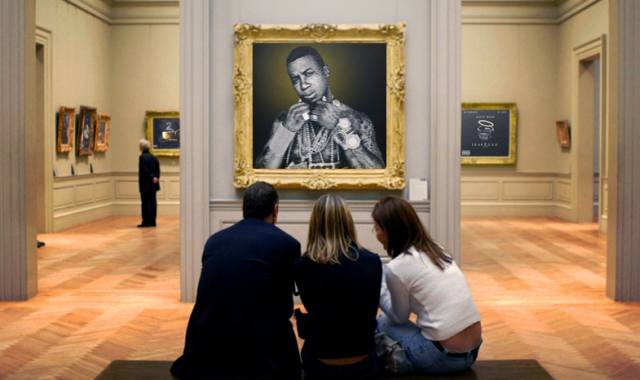
WHY GUCCI MANE IS THE MOST INFLUENTIAL RAPPER OF THE LAST DECADE
DO YOU AGREE ? NOISEY ATLANTA PLUS By David Drake Though he sits behind bars, Gucci Mane is all around us. He is the most influential underground rapper of the past decade, if not the most influential rapper point blank. Intentional or incidental, Gucci Mane’s virtual exclusion from last year’s VH1 documentary on Atlanta hip-hop is telling. That such a major actor was relegated to a footnote suggests his place in history remains contested. More damning—at least to the overlords who write popular music’s most prominent stories—was his inability to sustain crossover success in the vein of Lil Wayne, Jay Z, or Drake, proof-positive of his marginal status. In the 1990s, platinum album sales empowered gangster rap both within and outside the mainstream. But by the late 2000s, just as internet piracy was reaching its peak, the very real enthusiasm for Gucci’s work was much more ephemeral to measure—and easier to deny. Not that history’s ever a settled question, but Gucci’s position feels especially precarious. Of course, there are concrete reasons his music is so divisive. His catalog contains its fair share of misogyny. It also carries all the di rigeur trappings—cliches, to some, formal characteristics, to others—of pulp street rap, a genre often documented more by enthusiasts than historians (if academics deign to investigate the form, it’s seldom as a space for discrete art objects, tending more towards pathologizing of artists and fans—hip-hop as a source or consequence of cultural disfunction). At the same time, the case for his art can be just as uncritical: Celebrated as a wacky, colorful character, or as a one-dimensional deviation from the street rap mean, he’s rendered superficially, his work illegible—a stand-in for “ratchet” culture, as in 2013’s Spring Breakers. This trash-culture irreverence is something Gucci actively courts, and he’s not always wrong to do so—nothing sinks enthusiasm so swiftly as the grim obligations of seriousness. Yet ten years after the release of Trap House, his influence has penetrated much more deeply than any of his relevant peers. Hip-hop throughout the South and post-industrial Midwest is inundated with both amateur and professional Gucci disciples—an aesthetic diaspora an acquaintance labelled the “Sunz of Mane.” Young Jeezy, with a comparable level of success, had a much shallower bag of tricks; a kid might be inspired by his success, or learn from his experiences, but his music’s surface offers much less to emulate. Gucci’s work was populated with a surplus of ideas, from adlibs to concepts to diction, a teeming marketplace of innovations. There are no Mike Wills or Waka Flockas—artists who came up directly under Gucci’s tutelage—on Jeezy’s resume. Nor has Jeezy inspired a new generation of stars, as Gucci’s aesthetic so directly predicted the Migos and Chief Keef. And no one from CTE has risen quite as quickly as Young Thug after his time spent under Gucci’s wing. Thug belongs much more directly to Lil Wayne’s lineage than Gucci’s, but it’s unsurprising that Gucci was the first to reach out. Those two stars represented the twin aesthetic poles of street rap in the late ’00s. Listening to Lil Wayne was an experience of exceptionalism: the point where effortless wordplay reached its unattainable peak. By definition, there could be only one Wayne. He was a prodigal craftsman, one for whom no ideology would ever trump the art of potent wordplay, imagery, or fourth wall-breaking. Whether it was sexual or scatalogical, no joke was too low brow that it couldn’t be elevated, conveyed in the most clever, unpredictable manner. His transition to mass popularity required underlining this part of his appeal: At its center, his art was about excellence. And so his delivery slowed as he drew attention to these tricks. (This reached a parodic outer limit with the arrival of Young Money and the cartoonish hashtag punchline style in 2009.) Gucci, meanwhile, operated as his inverse, consistently downplaying any suggestion that he was a ‘lyrical’ rapper: “‘Damn, Gucci lyrical!’ Naw, I ain’t lyrical/ But my bracelet is crazy, but my necklace is hysterical.” For a rap artist who declined the “lyrical” tag, Gucci was one of hip-hop’s most dexterous, vivid, and imaginative writers. This seeming contradiction suggests not so much a qualitative divide between Gucci and Wayne as an ideological one. To Gucci, aesthetics were as much about his relationship to his audience as they were a self-contained goal, a way to connect as opposed to a way to transcend. Perhaps this approach can be traced back to an interview he gave to Murder Dog magazine in the mid 2000s, after the success of “Icy.” Born in Bessemer, Alabama and raised in Birmingham, Gucci moved to Atlanta at nine years of age. “The shit is so fast, I adapt so quick,” Gucci says of Atlanta. “I’m going to school up here on the east side of town. I blend all the shit I see up here with the way I talk and people just dig the shit. That’s my style and back, just that quick. It’s just like a country boy and a city boy all blended into one.” Aesthetically, this explains Gucci’s mumbled backwoods delivery and his fast life aspirations. But it’s about something deeper as well. The country boy isn’t unintelligent; he’s unsophisticated, a person humbly unfamiliar with the structures and grammar of institutional power. For a quick country kid adapting to the labyrinthine pathways of the music industry, lyricism is not an end in and of itself, but a tactic for holding the attention of an audience with an unquenchable thirst for new material. At his peak (roughly 2007-2010), every verse was undeniable, the must-hear moment in every song in which he appeared. (This tradition was in many ways more inspired by Bun B’s furious guest run in 2004 than Wayne’s prolific mixtape output—more writerly, less stylistically eccentric: “UGK my favorite group for years been rockin’ with them guys.”)


Chris Brown’s Probation Ends, Rihanna Assault Case Closed
This is a TGIF that Chris Brown can truly be thankful for. The singer’s felony probation as a result of his 2009 assault against then-girlfriend Rihanna has come to an end. Brown, along with his attorney Mark Geragos, appeared in front of Superior Court Judge James R. Brandlin in a Los Angeles courtroom earlier today (March 20), the AP reports. Brandlin put a close on the X creator’s Rihanna assault case after more than six years of being under the supervision of court and probation officials. To celebrate the news, Breezy, who showed up to court with a new purple ‘do, shared his excitement on Twitter. “IM OFF PROBATION!!!!!!!! Thank the Lord!!!!!!” the 25-year-old tweeted. “I couldn’t be more delighted,” Geragos said after the hearing. “He is in a spot right now and a place right now that I couldn’t be prouder of him.” The hearing was “a monumental feat for him,” Geragos said of Brown. The road to his probation’s end hasn’t been a smooth one. Since 2009, he’s had his fair share of missteps including throwing a chair through a window after a Good Morning America interview in 2011; getting involved in a brawl with Drake at a New York City club in 2012; fighting Frank Ocean and his crew in an L.A. parking lot in 2013; punching a man outside of a Washington, D.C. hotel a year later and several other incidents. He served 108 days in jail last year after graduating from a 90-day rehab program for violating his probation. Read More: Chris Brown’s Probation Ends, Rihanna Assault Case Closed | http://theboombox.com/chris-brown-probation-ends-rihanna-assault-case-closed/?trackback=tsmclip