

Author: JD
Colombia extradites alleged drug lord called ‘The Madman’ to US
AFP – Getty Images A man that authorities say is the most notorious Colombian drug lord since Pablo Escobar is now headed to the U.S. in handcuffs, after plastic surgery failed to conceal his identity from police. Daniel Barrera, AKA El Loco or The Madman, ran a 400-ton-per-year drug empire with the help of violent leftist guerrillas, and controlled the major cocaine smuggling routes from Colombia to the U.S. He burned off his fingerprints with acid and had cosmetic surgery on his face, but an international law enforcement task force was still able to track him to a phone booth in Venezuela in September. Colombian authorities have now extradited the 51-year-old to New York, where he faces drug trafficking and money laundering charges in two federal courts. He was set to arrive in New York in Tuesday, and will be arraigned in Manhattan on Wednesday morning and in Brooklyn on Thursday morning. After he is prosecuted in New York, he will be arraigned in the Southern District of Florida. Barrera’s career as a drug smuggler dates back to the 1980s, and he is believed to have shipped thousands of tons of cocaine north, often in cooperation with the leftist guerrillas of Fuerzas Armadas Revolucionarias de Colombia, or FARC. FARC has been the world’s largest supplier of cocaine and has engaged in bombings, massacres and kidnappings inside Colombia. FARC guerrillas allegedly provided Barrera with raw materials and charged him a monthly tax for establishing drug labs in their territory. Barrera was convicted on drug charges in Colombia in 1990 but escaped. After his escape, he used public telephones instead of cell phones to avoid surveillance by law enforcement. By the time he was caught by Venezuelan law enforcement last fall, authorities said he accumulated multiple dwellings, a yacht and 48 automobiles. Colombian President Juan Manuel Santos announced his capture on live television, saying, “We have caught the last of the great lords,” and thanked British and American authorities for their help. “In the fight against drug trafficking, this is a very important and final step,” Santos said at the time.
Who Would Recruit On Facebook? Try Pepsi, Gap, AIG And Oracle…
— by J.J. Colao V Facebook is quickly becoming a legitimate tool for recruiters. It’s easy to make fun of Facebook. The depressed stock, the misguided political comments, the unguarded vanity of high school “friends”—all tend to reinforce the inanity of the social network. But a billion people still use it. Even those who complain (like me) still use it. And for large, multinational companies, it’s becoming an increasingly valuable tool for recruiting employees. Work4, previously known as Work4 Labs, has been on our radar since the fall. Run by Stefane Le Viet, a 33-year old Frenchman, the San Francisco-based company helps companies like Pepsi, Gap and Oracle recruit for entry-level and hourly positions via Facebook. For the moment, it seems to be working. The company has posted 6 million jobs through its clients’ Facebook pages. Facebook itself began using the company to fill positions two weeks ago. “That pretty much killed any competitive threats we could’ve faced,” Le Viet laughs. BranchOut, a company that previously competed in the space,pivoted last fall. Companies like Identified and Jobvite offer competing tools. Monthly revenue at Work4, meanwhile, is doubling year-over-year. The company is on pace to make between $5-$10 million in 2013, up from “low millions” last year. For an 85-person company though, that still implies a serious burn-rate. Le Viet counters that developers in France, where Work4 headquarters its tech team, cost 1/3 of those in the U.S. after tax subsidies. And 30 of the company’s 85 employees are interns (whoa). Still, Work4 intends to raise more cash next year. It last raised $11 million in a Series A round led by Matrix Partners in September. Work4′s enterprise package starts at $10,000 annually, but increases as companies add features. Multinationals that maintain unique Facebook pages in different countries pay the $10,000 fee for each page. (Accenture, for example, pays for 25 different pages.) Small businesses can use a free service, but when they pay to advertise the openings through Facebook, Work4 takes a 25% cut. Since Work4′s enterprise business continues to generate nearly all of its sales, I asked Le Viet why he even bothers to target small businesses. “We spend a lot of time thinking about how to align as much as possible with Facebook,” he answers. Local, he explains, is a huge priority for the social network, so Work4 intends to continue working in that area regardless of the immediate ROI. Smaller customers are also helpful in terms of testing new services and features. That strategy illustrates the company’s current reliance on Facebook, something it is eager to mitigate going forward. It recently released a tool for recruiting through Twitter and intends to introduce a product for Pinterest in the coming months. A Facebook-oriented version of LinkedIn’s popular Recruiter tool is also in the works. Le Viet’s vision: “Social recruiting software for the enterprise.”
Was The Jay-Z Deal Worth It For Samsung?
Elite Daily — by Joseph Milord The deal that saw Samsung Mobile purchase a million copies of the heavily anticipated “Magna Carta Holy Grail” album for $5 million was a big win for Jay-Z. That much is clear. The move ensured that Mr. Carter’s album would essentially go platinum before its official release and he would be given the spotlight in the midst of the NBA Finals, turning millions of people’s attention away from basketball at a time when the game’s best player was contending for a title. On one end, success was undoubtedly attained. But for Samsung, the company that spent a total of $20 million on the marketing campaign centered around the release of Magna Carta Holy Grail and the app that allowed Galaxy phone users to access the tracks five days early on July 4, the question of profit has gone unanswered. So, on the day that #MCHG makes it’s official debut in stores, it seems appropriate to ask: What, exactly, has Samsung gained besides a whole bunch of publicity? There’s one theory that seems to be doing the rounds. “The more information users requested about the album, the more info they’d be asked to give up,” said Time.com writer Melissa Locker. “For example, if you wanted the lyrics to a song, the app posts on your behalf to Twitter or Facebook, alerting your friends and followers. The result has seen Twitter flooded with spam-like tweets, ‘I just unlocked a new lyric ‘Crown’ in the JAY Z Magna Carta app. See them first…’” In exchange for their money, Samsung has seemingly been committed to going after your personal information. With great resolve and tenacity, too, Galaxy S III, Galaxy S4 and Galaxy Note II users have seen the Korean company push the limits, asking for users’ location, phone call logs and other sensitive information. In retrospect, this is a little cringe-worthy. Don’t worry, though, said Jay-Z manager John McNeilly, it’s nothing. “It’s much ado about nothing,” McNeilly told Wall Street Journal reporter John Jurgensen. “You have to provide a lot more information than was asked for in this app when you buy music with a credit card. There’s no secret room with people trying to mine through and find out which other artists you like or don’t like.” But while much of the focus has been on Samsung’s NSA-like endeavors (Elite Daily covered the story, along with the New York Times, Journal, Time, and Gawker ), little attention has been paid to the fact that the company may be on the threshold of revolutionizing the phenomenon of the album release. Jay-Z may be the first to do it this way, but hyping up one’s tracks with the use of mobile apps is sure to not be a one time thing. Lady Gaga has already said that her next album release will involve an app, while McNeilly also told Jurgensen, “the reason we did the deal with Samsung is that hand-held devices will be the key to music distribution in the future.” If releasing albums through mobile apps becomes a trend, you could only expect Samsung to be at the forefront of the marketing campaigns that surround it or, at the very least, lead Apple in the potential race to get other artists on board, already with a head start from the Magna Carta sales. With more hyped up, music-centric advertisements inevitably would come more chances for Samsung to step on Apple’s toes, a process which is apparently already in the works. According to Tech Crunch’s Catherine Shu, Samsung plans to build a new $300 million facility in San Jose that will act as its U.S. headquarters. In addition, the company’s expansion of their presence in Silicon Valley — i.e. Apple Country — also features a $100 million strategy and innovation center in Menlo Park, the home of Facebook, and a start-up incubator in Palo Alto near Stanford University. Meanwhile, Forbes contributor Kelly Clay says that Samsung already owns a 38% share of the global smartphone space and that the tech giant could consider creating its own music store, like iTunes, as it tries to create a new revenue stream. And it’s all for one reason. Samsung is on the come up. Whether it’s through helping startups grow or revamping the way artists release their newest works, the company is intent on trying to usurp Apple as the world’s gold standard in the tech world.
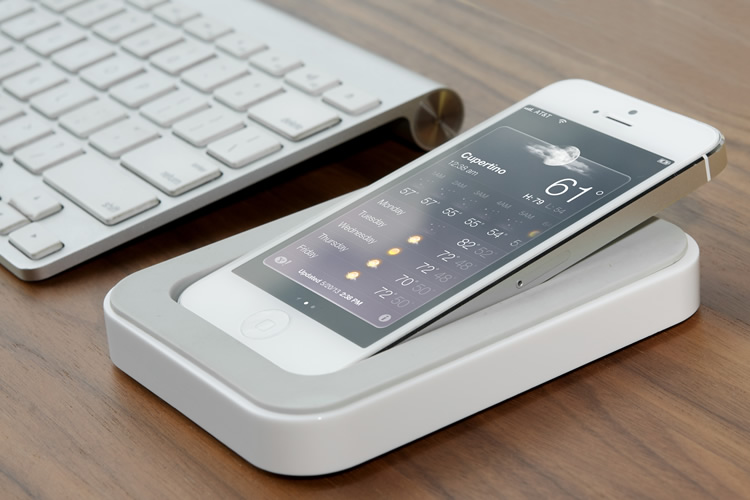
BLUELOUNGE SAIDOKA
One of the problems with charging docks is simply the awkward upright angle your phone sits at which makes it a bit uncomfortable to use when charging. Saidoka fixes that with an angled, upward-facing dock to make it easier to use your apps while charging in the dock. They’ve even made room for iPhones with cases with a removable rubber cover that adds more space to accomodate your phone’s cover. $30-$50, Bluelounge

Some of the World’s Biggest Athletes Naked
ESPN the Magazine presents its body issue – featuring over a dozen athletes in their natural form – showcasing the various frame types it takes to succeed in a range of professional sports. Featuring the likes of Niners QB Colin Kaepernick, Denver Nuggets Kenneth Faried, Funny Car driver Courtney Force and more,Check out the entire gallery here
Givenchy Baseball Print Jersey Sweatshirt
HARD !!! Inspired by his obsession with Americana, Givenchy designer Riccardo Tisci presents a baseball print crewneck sweater as part the new Givenchy Fall/Winter 2013 collection. While the front is mostly clean, the sleeves and back feature print elements that remind us of America’s national sport. You can purchase the sweater now from MR PORTER.

QUOTE OF THE DAY
“The world as we have created it is a process of our thinking. It cannot be changed without changing our thinking.” -Albert Einstein
Beats’ Daisy Music Service Dials Up Carriers
Looking to find a partner that can turbo charge sales of its soon-to-be-launched music streaming service, Beats Electronics has been quietly looking for a carrier partner that will bundle its upcoming subscription service with cell phone or data plans. Beats has started discussions with a number of carriers, including AT&T, to bundle Beats music with their mobile services, according to several people knowledgable with the talks. No deals have been struck and negotiations are still in their exploratory stage, sources said. Beats declined to comment. For Beats, the primary advantage of partnering with a carrier is the ability to piggyback monthly fees on top of carrier bills, making it easier for consumers to pay for the music service and also less likely to cancel the service once payments are automatically integrated with an existing bill. Carriers such as AT&T can also leverage their existing relationships with millions of customers to sell them a music service on their new mobile devices. For AT&T and other carriers, a music service has the potential to reduce customer churn, a costly phenomenon in the cell phone business. Telecommunications companies have looked to Cricket Communications’ popular Muve Music Service as an example of how music can generate additional revenue and create an incentive for subscribers to remain with Cricket. Beats’ partnership with a carrier could function similarly to how SiriusXM Radio currently works with auto dealers. Car buyers are usually able to access Sirius’ satellite radio service for free during a trial period. At the end of the trial period, they would be billed for the monthly service. Dealers are compensated for every listener they turn on to Sirius. Such an arrangement could also apply to a deal between Beats and a carrier. AT&T is a natural first stop for Beats, which has an ongoing retail relationship with the carrier to sell the company’s headphones and audio gear in AT&T’s stores. Beats even created an exclusive version of its portable Pill speaker — a Pink number endorsed by Nicki Minaj — released just for AT&T stores this spring. But the discussions to distribute Beats’ music service, code-named “Daisy,” is occuring with other carriers as well, sources told Billboard. The music service hasn’t even launched, yet it already has the involvement of some of the industry’s most high-profile names. Trent Reznor last year joined Beats as creative chief. In January, Beats hired Ian Rogers, former head of Topspin and Yahoo Music chief, as chief executive. And in March, Daisy was on the receiving end of a $60 million group investment led by billionaire Len Blavatnik’s Access Industries, which also owns Warner Music Group. Beats isn’t the only music company calling up carriers to talk about distribution. Spotify, Rhapsody, Slacker and Rdio also have telecom companies on speed-dial in the hopes that a partnership can help bring to mainstream audiences a music model that has so far captured an estimated 20 million subscribers worldwide. That compares with more than 6.8 billion cell phone subscribersglobally, according to the International Telecommunications Union. Looked at another way, if Beats and other music services can capture even 1% of cell phone customers, music subscriptions would more than triple its current penetration.