

Author: JD
Hoffman’s Heroin Points to Surge in Grim Trade
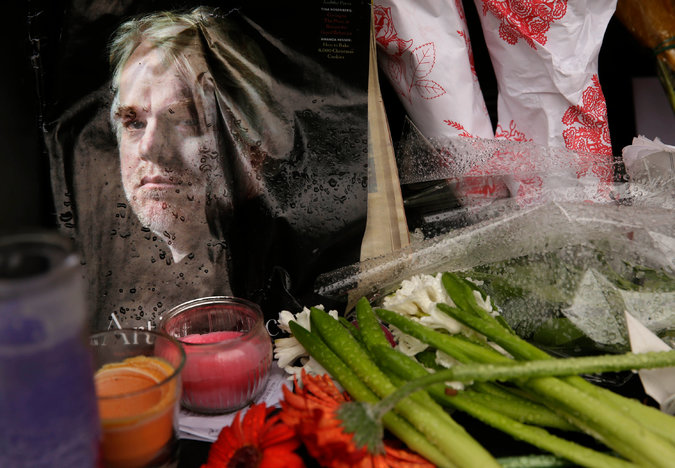
Detectives found dozens of small packages in the West Village apartment where Philip Seymour Hoffman, the actor, died on Sunday. Most were branded, some with purple letters spelling out Ace of Spades, others bearing the mark of an ace of hearts. At least five were empty, and in the trash. Each of the packages, which can sell for as little as $6 on the street, offered a grim window into Mr. Hoffman’s personal struggle with a resurgent addiction that ultimately, the police said, proved fatal. And the names and logos reflect a fevered underground marketing effort in a city that is awash in cheap heroin. Heroin seizures in New York State are up 67 percent over the last four years, the federal Drug Enforcement Administration said. Last year, the agency’s New York office seized 144 kilograms of heroin, nearly 20 percent of its seizures nationwide, valued at roughly $43 million. One recent raid, in the Bronx last week, netted 33 pounds of heroin and hundreds of thousands of branded bags, some stamped “N.F.L.,” a timely nod to the Super Bowl. Launch media viewer New York drug seizures have produced envelopes of heroin stamped Kill Zone. Drug Enforcement Agency From 2010 to 2012, after several years of decline, heroin-related overdose deaths increased 84 percent in New York City to 382, according to the Health Department statistics. Staten Island, where prescription drug addiction has been especially virulent, has the city’s highest rate of heroin overdoses, though a connection has not been established. Bags bearing different stamps turn up in raids of large-scale heroin mills around the city. They are named for popular celebrities or luxury products, or the very thoroughfares along which the drugs travel: Lady Gaga. Gucci. I-95. They reflect an increasingly young and middle-class clientele, who often move from prescription pills to needles: Twilight. MySpace. And they often indicate little about the quality or purity of the product, which is diluted with baking soda or, in some cases, infant laxatives, officials said. To be sure, there is variety, especially in potency and reliability. Recently, 22 people died in and around Pittsburgh after overdosing from a batch of heroin mixed with fentanyl, a powerful opiate usually found in patches given to cancer patients. Heroin containing fentanyl, which gives a more intense but potentially more dangerous high, has begun to appear in New York City, said Kati Cornell, a spokeswoman for Bridget G. Brennan, the special narcotics prosecutor for the city. An undercover officer bought fentanyl-laced heroin on Jan. 14 from a dealer in the Bronx, she said. The dealer did not warn of the mixture, which is not apparent to the user; subsequent testing revealed it. (The patches themselves had turned up in drug seizures in the city before, she said.) Ultimately, users have no way to be sure what they’re buying. “There’s no F.D.A. approval; it’s made however they decide to make it that day,” Ms. Brennan said. The same shipment of heroin may be packaged under several different labels, she said. “At the big mills, we’ll seize 20 stamps. It’s all the same.” Far from plaguing only big cities, heroin has emerged as a grave concern in places like Vermont, where last month the governor devoted his entire State of the State message to what he said was “a full-blown heroin crisis” there. But almost as long as there has been heroin in the United States, New York City has been its hub. Certainly much has changed since the 1970s, when addicts flooded shooting galleries and flashy drug traffickers like Nicky Barnes, known as Mr. Untouchable, became household names. The drug is still smuggled into the country from faraway poppy fields, still cut from kilo-size quantities in hothouse operations secreted around the city, still diluted in coffee grinders and still sold to needy consumers. Various brands, too, have been around for decades. “There always have been markings going back as far as Nicky Barnes,” said James J. Hunt, the acting head of the Drug Enforcement Administration’s New York office. “Now the difference is that the addicts you see a lot are young suburban kids starting on prescription drugs, and they graduate to heroin.” The trade has become more organized, officials said, from the top to the bottom. Delivery services abound for those who can afford a dealer who arrives at the door with a grab bag of drugs. Highly organized mills have been found in middle-class city areas like Riverdale, in the Bronx, and Fort Lee, N.J., or, in one case, in a Midtown Manhattan apartment near the Lincoln Tunnel. Such locations draw less scrutiny from potential robbers, and often provide ready access to major roads for deliveries up and down the Eastern corridor. “It’s like somebody setting up a big production factory in China and the product is going to go out through to the world,” Ms. Brennan said. “That’s how I look at these production mills that we’re seeing in New York. Some will stay here in the city, but it’s mostly intended for distribution.” (A $6 bag in the city could fetch as much as $30 or $40 in parts of New England, authorities have said.) Launch media viewer Bags bearing different stamps, like Twilight, turn up in raids around the city. Drug Enforcement Agency Some officials fear that efforts to drive down abuse of prescription medications could be contributing to rising heroin use in New York City, as it has in places like Maine. “What we’re seeing, as pills become more difficult to access, is a shift to the black market and heroin,” said Dr. Andrew Kolodny, the chief medical officer at the Phoenix House Foundation, a drug-treatment center, and president of Physicians for Responsible Opioid Prescribing. “It’s not easy to get the opioid genie back into the bottle.” It is a cycle that friends of Mr. Hoffman, who was 46, said may have recently taken hold in his life as well. Last year, he checked into a rehabilitation program for about 10 days, a move that came after a reliance on prescription pills led to a return to heroin, after what he said had been a clean period spanning two decades. The Police Department on Monday said detectives were working to track down the origin of the substances Mr. Hoffman used, though a police official conceded it could be difficult to determine. “Just because it’s a name brand doesn’t mean that anyone has an exclusive on that name,” the official said. “Ace of Spades; I would venture to say that someone else has used that name.” The ace of hearts logo has appeared in at least one case in the city, the police said. The Drug Enforcement Administration said it had seen “Ace of Spades” branding in a 2009 drug case on Long Island. It has been seen in photographs of heroin packages at least as far back as 2005. Investigators will also test the paraphernalia found near Mr. Hoffman, as well as the syringe found in his left arm, to determine whether the mixture he consumed had been adulterated in any way, the official said. Results from those tests were expected sooner than the toxicology tests by the city medical examiner. 53COMMENTS For law enforcement officials, Mr. Hoffman’s death was a stark reminder of the dangers inherent in a highly addictive drug that ravaged urban communities in the 1970s. “People who study drug trends talk about generational amnesia,” said Ms. Brennan, the special narcotics prosecutor. “We’re now 40 years out from our last major heroin epidemic and I think people have lost their memory of that drug’s devastation.” Indeed, she said, some of the most common heroin brands suggest as much: Grim Reaper; a skull and crossbones; D.O.A.
Porn Star Breaks Manhood, Seeks Donations For Medical Bills
WTH!!!! You can’t make this kind of stuff up. A porn star has broken his penis for the second time and is seeking donations to pay his $32,000 medical bills. Porn actor Prince Yahshua first broke his money maker three years ago during a shoot. A couple of weeks ago, the injury was aggravated enough for him to require medical attention. At the hospital, it was discovered he had actually broken his penis for the second time. Prince Yahshua found out it would cost $32,000 for the surgery to repair his johnson and the subsequent rehabilitation. Yahshua’s reps have started a fundraising campaign on GiveForward.com to help raise the $32,000 for the actor’s medical expenses. Prince Yahshua released a statement to AVN.com, “Blown away is what I feel right now. I’m saddened to tell the industry and my diehard fans around the world that the injury that sidelined me three years ago has come back to bite me in a big way. After seeing and talking to my doctor on Friday, I was informed once again that I must go under the knife to repair bad tissue damage asap. Today, my heart is a lot happier after seeing what Sandra [McCarthy] and OCM has done for me by starting this fundraiser—I’m speechless! I’d like to thank Sandra, OCM and the fans and companies that have made me who I am today.” The owner of the agency that reps Prince Yahshua stated, “When Prince contacted me with the devastating news, I was at a loss for words … tears were rolling down my cheeks. I knew I needed to help him emotionally and financially, so I started this fundraiser to help ease the pressure of the huge expenses that were on the way. Healthcare is unaffordable, and Prince doesn’t have a plan due to his pre-existing condition, so he’ll have to pay for the entire surgery out-of-pocket. Lately, the industry seems to have been taking hit after hit, but we all need to stick together and unite as one so we can get through whatever life throws at us.” If you can find it in your heart to donate to his medical fund, click here. UPDATE: We just spoke to Prince Yahshua and he told us that the stories being written aren’t as serious as the situation actually is. According to Prince, he has developed some scar tissue from the first surgery he got to repair his manhood three years ago. Also, he had absolutely no idea his modeling reps were setting up the GiveForward account for him, but he is grateful for it. This surgery will sideline him from acting in films for about a month. So fret not Prince Yahshua fans, he’s down, but not defeated.
Paper Now Available For iOS In The US, And It Could Be A Facebook Replacement
Facebook’s new standalone app Paper is now available for download on iOS to everyone in the US, and it’s more than just a content reader. Paper has messages, notifications, search, and a completely redesigned profile. When I asked the team leaders behind Paper if they still used the old one, product manager Michael Reckhow diplomatically responded “mmhmm, yeah”, but designer Mike Matas just smiled coyly. I pounced, repeating my question just to him. “Once in a while”. He’d spilled the beans. Paper could be a Facebook killer. “Mostly I use this [Paper]” Matas continued. “There’s some features that it doesn’t have like if uhh….Events is a good example, like if I need to go find an event.” I pressed, “But otherwise you’re finding this does enough?” “For my usage, yeah”, Matas replied. Facebook announced today’s release of Paper last Thursday. You can check out details about how it works and what it means there, but essentially it’s the next step in CEO Mark Zuckerberg’s vision of Facebook spawning a family of mobile apps with different specific purposes. Built as part of Facebook’s new “Creative Labs” standalone app initiative, Paper lets you choose different content “Sections” to add to a sort of digital newspaper. You can then browse a redesigned News Feed and your Paper sections to read stories from friends, big publishers, public figures, and emerging content creators in a stylized full-screen format. Paper also lets you share content with a visual composer that shows a preview of exactly how your post will look to other users. Paper for iOS is free to download for anyone in the US with iOS 7 or later. Facebook hasn’t mentioned any immediate plans for an iPad or Android version. It shares a name with several existing apps including a drawing tool developed by FiftyThree which has asked Facebook to change the title of its new product. [Update 11:15am PST: Facebook has given a “no comment” but may get to keep the name because FiftyThree registered its trademark for “Paper By FiftyThree” not “Paper”.] When I visited 1 Hacker Way Friday to demo Paper, I knew I’d see plenty of intricate animations and next-level UI tricks. But I was less interested in how we might use Paper than in how it might change how we use Facebook’s main app. I’d heard whispers that certain higher-ups at the company had almost entirely switched from Facebook for iOS to Paper, and some of the standalone app’s team members haven’t had the old Facebook installed on their phones in months. Zuckerberg is certainly enjoying Paper. Reckhow tells me, “He loves it. He uses it, and he’s just excited to launch like we are. We’ve met regularly with him…And he gives feedback along the way. I think one area where he definitely challenged us was to think of the content as really broad and to think past the typical areas that you’d think of browsing content.” Reckhow was conservative about his hopes for the launch, saying the team has no specific download or engagement goals, but instead just hopes they’ve created something people will love using. He told me: “It’s such a great opportunity for us to launch something that people can just go and check out in the App store, see how it’s going to fit into their lives and their homescreens, install it, and then just try it out and it doesn’t affect their experience they have already and they can figure out what the right way to use Facebook is. it’s not really our job to tell them ‘this is how you should use Facebook right now and everyone has to use it in the same way.’” But Matas and Reckhow were candid about how they think Paper improves on what’s broken about the current Facebook mobile app. Matas told me: “I’ve been in a situation where you’re watching the sunset over the grand canyon and you’re like ‘this is the most beautiful, amazing thing I’ve ever seen. I need to share this with people.’ You take the photo and put it on Facebook and it’s cluttered with a bunch of blue chrome, the photo is super small and pixelated, and it just totally sucks the soul out of the photo.” Paper began as a way to give this content the presentation it deserves, but that beautification has bled out to much of the rest of Facebook. Messages and Notifications can be opened over the top of Paper so they don’t drag you away from your current screen. Profiles, Pages, and Events now have a truly mobile-first design that centers around images and swipeable full-screen cards to convey the most important images. Anything unnecessary was left out. In the end, Paper is a full-fledged yet simplified Facebook client that brings a new focus on aesthetics to the social network. [Update 5:45pm PST: In fact, Paper is purposefully designed to be a Facebook killer. Quietly buried in the settings is the ability to open push notifications from Facebook in Paper instead of Facebook for iOS. Facebook is actually giving you a hand in switching entirely to Paper.] What if Paper gets so popular it starts becoming people’s default Facebook mobile experience? Reckhow says “It’s a good problem to have”.
Bruno Mars Scores Most-Watched Super Bowl Halftime Show Ever
Bruno Mars and the Red Hot Chili Peppers Perform at Super Bowl XLVIII on Feb. 2, 2014 in New Jersey Bruno Mars and the Red Hot Chili Peppers’ performance attracted the largest audience in the history of Super Bowls, attracting 115.3 million viewers, Fox announced Monday, citing Nielsen data. That figure surpasses the prior record of 114.0 million set by Madonna two years ago and the 110.8 million who tuned in to see Beyonce last year. More on the Super Bowl Bruno Mars’ ‘Jukebox’ Sales Jump 164% After Super Bowl Halftime Performance Super Bowl Ads: All the Music-Related Spots (Updated) Super Bowl at MetLife Stadium: An Inside Look at Hosting the Big Game (Q&A) Mars sang “Give it Away” with the Peppers, executed James Brown dance moves and Police riffs and closed with his hit ballad “Just the Way You Are” at halftime of a blowout won by the Seattle Seahawks, 43-8. The game had an average viewing audience of 111.5 million viewers, the largest in history. The final number was significantly higher than than 98.88 million viewers reported in the overnight ratings from Nielsen that measure the top 56 markets. It initially appeared Super Bowl XLVIII would be the fifth most-watched in history. The one musician who may well have received the most exposure for new music is Prince, who guest-starred on “New Girl” immediately after the game. The episode, watched by nearly 26 million viewers, included a performance of his new song “PretzelBodyLogic.”
What’s New in Serato DJ 1.6
Along with Rane Hardware support, Serato DJ 1.6 includes the Pitch ‘N Time DJ Expansion Pack, Quantize, Nameable Cue Points, Jet Pack FX Expansion Pack, support for the Pioneer DDJ-SZ & Numark V7 Pro Controllers and the brand new Denon DJ MC6000MKII & Reloop Terminal Mix 8 DJ Intro Controllers. Plus a healthy dose of maintenance bug fixes for continued stability and performance. http://youtu.be/kymmp-Tg_cs
YouTube Has Paid Out $1 billion to Music Industry In Last Few Years
Tom Pickett, Vice President of Content of YouTube, speaking on a Midem 2014 panel about online video. Google Inc. disclosed on Sunday that its YouTube video platform has paid out more than $1 billion to music rights holders “over the last several years,” putting the California technology company among the top sources of digital revenue for the embattled music industry outside of download sales. The statement, made by YouTube VP of content Tom Pickett, came in answer to a question during a panel discussion at Midem in Cannes, France, about how much value Google as a technology platform places on music and whether artists are making meaningful money by being on the platform. YouTube had earlier stated that it has paid “hundreds of millions of dollars” to the music industry. “We are very much into music,” Pickett said, adding later that, “If you think about it, we’ve paid out to the music industry over the last several years over $1 billion. So there is money being generated in this ad-supported model. It is going to artists.” Pickett pointed out that the money YouTube pays out goes to “thousands and thousands” of musicians and rights holders, addressing the complaint that some individual artists may not see large checks because the per-view payment is relatively small. Jordan Berliant, a panel member and head of music management at The Collective Music Group which represents Linkin Park, Stone Temple Pilots and Staind, added that YouTube “can be a place to make money,” but that, “It’s not a place to make money right now.” Berliant added that he doesn’t blame YouTube, whose business model relies largely on advertising, which in turn relies on having a massive audience. The session got testy when panelist Geoff Taylor, the chief executive of BPI and the BRIT Awards, referred the revenue his artists receive from YouTube and other ad-supported music streaming services as “pennies and pence,” when compared to paid streaming services such as Spotify’s premium tier and Deezer. Taylor said he hoped YouTube will develop a “mixed model” that also includes a paid subscription service. YouTube already has the necessary music licenses to launch a paid subscription music streaming product and is expected to launch its service sometime this year. Taylor took another shot at Google towards the end of the session, accusing the search giant of doing little to remove links to illegal sites that distribute pirated music or sell software that can be used to record music videos on YouTube, Vevo and elsewhere. “When you know that stuff is illegal, you surely have got the responsibility to take that knowledge into account and do something with your search rankings, which gives the legal sites a chance to put themselves in front of consumers rather than the pirate sites,” Taylor said. “To have a really productive partnership, Google and YouTube need to do more on that.”
Apple Looks to the Next 30 Years with “1.24.14″ Film
Thirty years ago Macintosh promised to put technology in the hands of the people. To celebrate Mac’s birthday, this film was shot around the world in one day, entirely on iPhone. Here’s to the next thirty. http://youtu.be/zJahlKPCL9g

Why Hasn’t Heroin Killed More Rappers? by Nathan S.
Early yesterday, when I was preparing for a Super Bowl that would turn out to be utterly forgettable, I was hit with the news that one of the greatest actors of the last two decades had died. At the tragic age of 46, Phillip Seymour Hoffman was found dead of a reported heroin overdose, joining a long list of brilliant artists before him who have been laid low by heroin. A list that, astoundingly, doesn’t appear to include any hip-hop artists. Name an art form and the list of heroin overdoses quickly becomes, in the words of Kendrick Lamar, IVs on top of IVs, bodies on top of bodies. In film Hoffman, River Phoenix and too many more to name here overdosed on heroin. In rock, Janis Joplin, Jim Morrison, Bradley Nowell and too many more to name have overdosed on heroin. In comedy, Lenny Bruce, Mitch Hedberg and many more. In jazz, Chet Baker and many more. In art, Basquiat and many more. In writing, Jim Carroll and many more. In hip-hop…… And those are just the people who had died from heroin overdoses, thousands more have been addicted and eventually died from other drugs/mixes of drugs (Jim Belushi, Billie Holiday, Charlie Parker, Chris Farley, etc.), some miraculously never overdosed despite decades of use (William Burroughs, Keith Richards, Miles Davis, etc.) and others are still either using or in recovery (Russell Brand, Artie Lang, etc). And yet…in hip-hop I’m hard pressed to name one rapper or producer who’s even been known to have been addicted to heroin, let alone over-dosed. After some internet research I remembered that Chris Kelly of Kriss-Kross had died of a reported cocaine-heroin overdose, and that’s the list right now. Even Eminem, who by his own admission took every prescription drug known to man, apparently never touched heroin. Pimp C died from a combination of syrup and respiratory problems, and Ol’ Dirty Bastard, one of rap’s most iconic and well-known hardcore drug users, overdosed from a combination of cocaine and prescription drugs. more recently, Danny Brown, a man not particularly shy about detailing his drug use, seemingly hasn’t mentioned heroin. Really, as of right now the only rapper I can even find who’s spoken about his heroin use is Turk (of the Hot Boys), who detailed he and B.G.’s cocaine and heroin use in a HipHopDX interview: Turk: I was shooting heroin and cocaine, and I introduced B.G. to shooting heroin and cocaine. We was on the Cash Money/Ruff Ryders tour. B.G. had been getting high; I had been getting high. In New Orleans, Uptown, that’s the drug of choice, heroin. You got kids, 12, 13-years-old on heroin. As I was coming up, people glorified it like they do mollies today. They say “pop a molly, I’m sweating,” they rap about it and this and that. Soulja Slim, who was Magnolia Slim at the time, used to rap about heroin all the time. Partners-N-Crime also had a song about heroin. And that was the song. And the girls used to always say they want the dope dikk. So [I was like], “shyt, let me go on ahead and snort me a bag of heroin and fukk this bytch all night.” That’s what influenced us to do it. How is it that literally hundreds of notable artists in seemingly every modern medium and genre have struggled with heroin, but so few in hip-hop? Not even one major rapper has ever overdosed, or struggled with a well known addiction? How is that even possible? The first explanation is that rappers, for whatever reason, just don’t use heroin. Anecdotally that seems true, the drug has yet to become a cultural touchstone in hip-hop like it has in rock, but it still doesn’t really account for a nearly complete lack of known. Maybe unlike rock or jazz, which is more flexible and moody, hip-hop demands more energy, and so low-energy heroin users just don’t make it in hip-hop? That sounds like a convoluted theory as I type it, and really doesn’t make sense considering how many famous high energy metal and punk-rock artists used heroin. Maybe it’s just more hidden in hip-hop? But as Turk mentioned, heroin is still far from a stranger to the art form. And if by “rappers” we’re candid enough to admit that we’re talking about Black artists, it’s even more confusing. Heroin is rampant throughout many of the Black communities famous rappers have come from (they often rap about selling those drugs), and according to the Office of National Drug Control Policy, Black users account for the second largest racial category of heroin addicts in America. So how have rappers remained so seemingly untouched by the drug that has destroyed the so many around them? The acting community has been rocked time and time again as heroin overdoses felled their heroes, and the same goes for rock, art, literature and more. And yet, with all respect to Chris Kelly, the next notable hip-hop artists to die from heroin, will be its first. Some questions are better off going unanswered, and hopefully we’ll never be able to list the rappers who have been lost to the ravages of heroin, but as I mourn the loss of Hoffman, I still can’t help but wonder how the music I love most has managed to avoid the terrible touch of heroin.